To best analyze how the distribution of various roles influence offensive efficiency, we want to do so independent of the sum. This means reducing the per possession numbers of each player to a percentage of the team or lineup total, which is realistic with lineup or by position data, as opposed to the original data set comprised of players not on the floor together much of the time.
Season lineup data was used in this analysis. By position data was found to be unconducive to the analysis of the distribution of roles or statistics, for a few reasons. Most importantly, the same player can account for statistics at multiple positions throughout a game. Also, by position data combines multiple players at each position, each of which may bring a different set of skills. As a result, this makes it difficult to determine how the roles and statistics are actually distributed. For example, three-point attempts may be taken by only the guards in a starting lineup, but by only the forwards in a second unit. Although the three-point attempts are broadly distributed in each lineup, when the statistics of the two lineups are combined, the distribution looks even. This wasn't as much of a problem with the prior analysis as the standard deviations analyzed were not sum independent; sums that weighed heavily into the results. With lineup data, we are able to look at specific players, with specific skills, which is ideal for studying the distribution of roles. The true distribution analysis for offensive efficiency is below.
Field Goal Attempts
The analysis shows that a wider distribution of field goal attempts can make a difference of as much as 1.7 points per 100 possessions. This may not appear too significant, but when considered with the results regarding the distribution of three-point attempts, where an even distribution proves beneficial, we can conclude that a wider distribution of two-point field goal attempts has a greater effect than the distribution of overall field goal attempts suggests.
Three-Point Attempts
Unlike the previous results, this analysis shows that a more even distribution of three-point attempts can increase offensive efficiency by 12 points per 100 possessions. This implies that the previous results regarding three-point attempts were influenced more by the total three-point attempts than the distribution of those attempts, indicating that offensive efficiency increases as three-point attempts per possession increases, but that a more even distribution of those attempts is preferred. So, not only do we want skilled three-point shooters taking many shots, we want many of them spread around the floor.
Free Throw Attempts
The analysis shows that a more even distribution of free throw attempts can make a difference of as much as 10 points per 100 possessions. This implies that the previous results regarding free throw attempts were influenced more by the total free throw attempts than the distribution of those attempts, indicating that offensive efficiency increases as free throw attempts per possession increases, but that a more even distribution of those attempts is preferred. Lineups with multiple players capable of attacking the rim and earn free throw attempts are more efficient than those that get most of their free throw attempts from a player or two.
Offensive Rebounds
This analysis shows that a more even distribution of offensive rebounds can increase offensive efficiency by almost 3 points per 100 possessions. This indicates that lineups with multiple players capable of grabbing offensive rebounds are more efficient than those with a player or two that get most of the lineup's offensive rebounds.
Assists
Unlike the previous results, this analysis shows that a more even distribution of assists can increase offensive efficiency by 6 points per 100 possessions. This implies that the previous results regarding assists were influenced more by the total assists than the distribution of assists, indicating that offensive efficiency increases as assists per possession increases, but that a more even distribution of assists is preferred.
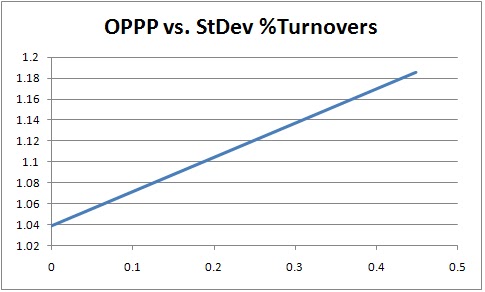
Turnovers
Unlike the previous results, this analysis shows that a wider distribution of turnovers can increase offensive efficiency by 15 points per 100 possessions. This implies that the previous results regarding turnovers were influenced more by the total turnovers than the distribution of turnovers, indicating that although offensive efficiency increases as turnovers per possession decreases, a wider distribution of turnovers is preferred.